
If you're noticing lukewarm air from the vents, ice on the coils, hissing near the lines, or oily stains at the fittings, your system is almost certainly losing refrigerant. These are the four most reliable refrigerant leak symptoms, and none of them get fixed by adding more refrigerant. Call a licensed technician for proper leak detection and an EPA-compliant repair.
TL;DR:
- Refrigerant leaks often present with ice on coils, hissing sounds, oily stains, or lukewarm air, which require professional detection and repair.
- Slow performance decline in cooling, increased energy bills, and frost formation are signs that the refrigerant level is critically low.
- Visual inspections, electronic leak detectors, UV dye tracing, and nitrogen pressure tests are essential tools for accurately locating refrigerant leaks.
- Handling refrigerant requires certified technicians due to high pressure, potential flammability, and safety hazards involved in repair procedures.
- Early detection through routine maintenance and monitoring can prevent expensive repairs and help maintain indoor air quality and system efficiency.
Table of Contents
- Refrigerant Leak Symptoms: The Full Checklist and How to Prioritize Them
- Why Low Refrigerant Causes These Specific Symptoms
- How Technicians Confirm and Locate a Refrigerant Leak
- What to Do the Moment You Suspect a Leak
- Repair Paths, Verification Steps, and What Drives the Cost
- Preventive Maintenance That Catches Leaks Early
- Health and Indoor Air Quality Effects You Should Watch For
- Safety Hazards Worth Understanding Before You Call
- Signs a Homeowner Can Catch Before Calling a Professional
- Do Symptoms Differ by Refrigerant Type?
- Encode's Field Checklist for Reporting a Suspected Leak
- Getting Your Leak Diagnosed and Fixed by Encode
- Sources
Refrigerant Leak Symptoms: The Full Checklist and How to Prioritize Them
Not every warning sign carries the same urgency. Some tell you to schedule a visit this week; others mean you should call today.
Reduced cooling and longer run times show up first in most homes and offices. The air coming from the vents feels warm or barely cool, and the system runs almost continuously trying to hit the thermostat setpoint. If you track your utility bill, this often shows up as a jump in kilowatt-hour usage without a change in weather or occupancy. Compare this month's bill to the same month last year. An unexplained increase is a real clue.
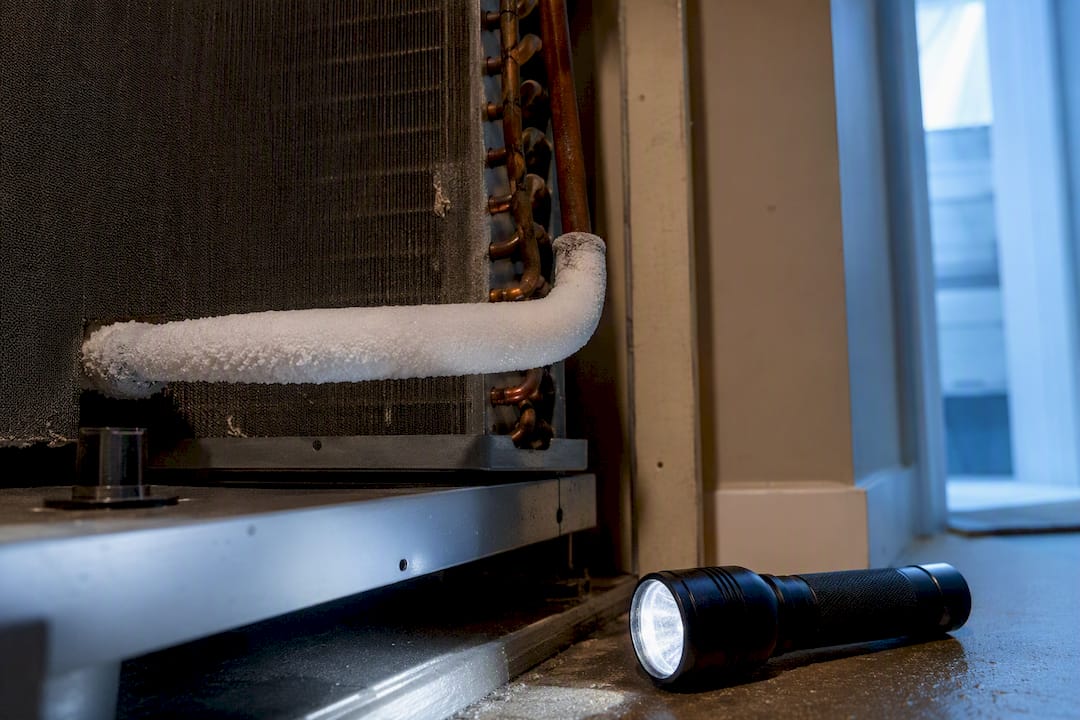
Ice or frost on the evaporator coil or suction line is one of the strongest indicators of low refrigerant. Frost forming on a line that should just be cool to the touch, or a visibly iced-over indoor coil, strongly points to low suction pressure caused by refrigerant loss.
Hissing or bubbling sounds near the refrigerant lines, indoor coil, or outdoor unit deserve immediate attention. A steady hiss usually means refrigerant is escaping through a small hole under pressure. A gurgling or bubbling noise can mean a mix of liquid and gas is passing through a spot it shouldn't.
Oily residue or dark staining at joints, flare fittings, and service ports is physical evidence you can often see without a flashlight. Refrigerant carries lubricating oil through the system, and when it escapes through a leak point, the oil migrates with it and leaves a greasy, dark spot behind.
A few other clues round out the list: uneven cooling between rooms, indoor air that feels more humid than usual, and, on older systems still running R-22, a faint sweet chemical odor. That odor alone isn't a reliable diagnostic tool, but paired with warm air and rising bills, it's another data point worth mentioning to whoever answers your service call.
Why Low Refrigerant Causes These Specific Symptoms
Refrigerant's whole job is moving heat out of your building. It absorbs heat indoors as it evaporates, then releases that heat outside as it condenses back into a liquid. When the system runs low on charge, there's simply not enough refrigerant to carry heat at the rate the system was designed for, so the air coming out of the vents stays warm.
That same shortage explains the ice. Less refrigerant means lower pressure inside the suction line, and lower pressure drags the temperature down far enough that moisture in the air freezes directly onto the coil or line surface. It's a mechanical result of pressure and temperature moving together, not a separate problem.
The oil staining follows the same physics that caused the leak in the first place. Refrigerant oil travels through the entire loop, so wherever refrigerant escapes, some oil escapes with it. And because the system is starved for refrigerant, the compressor works harder and longer to move whatever heat it can, which is exactly why run times stretch out and energy bills climb.
How Technicians Confirm and Locate a Refrigerant Leak
A visual scan for oil stains, corrosion, or obvious physical damage to the lines is always the starting point. It's fast, and it often narrows the search area before any tools come out.
- Electronic leak detectors. Heated diode, infrared, and ultrasonic detectors are far more sensitive than visual inspection and can pick up leaks too small to see or hear. A tech will slowly sweep the detector along joints, valves, and coil bends.
- UV dye tracing. A fluorescent dye gets added to the system, circulates with the refrigerant and oil, and glows under UV light at the leak point. It's useful for small, intermittent leaks, but some manufacturers restrict or void warranty coverage if dye is introduced without approval, so a good technician checks that first.
- Nitrogen pressure testing. The system gets pressurized with dry nitrogen and monitored for pressure decay over time. A steady drop confirms there's a leak somewhere in the sealed circuit, even before the exact spot is pinpointed.
- Evacuation and recharge. Once the leak is repaired, the technician pulls a deep vacuum, often down to 500 microns or lower, and recharges the system to the exact weight specified by the manufacturer rather than "topping off" by feel.
Pro Tip: If a technician offers to just add refrigerant without running any of these tests first, that's a red flag. Topping off a leaking system without finding and fixing the leak is a temporary patch that violates federal repair rules and usually costs you more in the long run.
What to Do the Moment You Suspect a Leak
Most household refrigerant leaks are gradual and don't create an emergency, but a few situations call for faster action. If you notice a strong chemical smell that's getting stronger, or anyone in the space starts feeling unusually unwell, ventilate the area, move people out, and call for help right away.
Beyond that, a little documentation goes a long way toward a faster diagnosis:
- Take photos of any oily residue, frost, or staining you can see.
- Write down your thermostat setting and how long the system has been running to hit it.
- Note roughly when the symptoms started and whether they've gotten worse.
- Have your system's make, model, and age ready, along with any recent service history.
- Skip the DIY refrigerant top-off. It's against EPA rules for anyone without proper certification and equipment, and it can mask the real problem while damaging the compressor.
Repair Paths, Verification Steps, and What Drives the Cost
Small leaks at accessible points are usually the cheapest fix. A worn Schrader valve core, a loose flare fitting, or a brazed joint that's failed can often be repaired directly, then verified with the same nitrogen pressure test used to find it in the first place.
Bigger jobs are a different story. If a technician finds multiple pinholes in the same coil, or formicary corrosion eating through the coil's hairpin bends, patching isn't practical. Coil replacement, and in more severe cases a compressor swap, becomes the recommended path.
Whatever the repair, the verification steps don't change:
- Pressure test the repaired section with nitrogen to confirm the leak is actually sealed.
- Evacuate the system to the manufacturer's specified micron level, removing moisture and air along with any residual refrigerant.
- Recharge by weight to the exact amount listed on the equipment nameplate, never by guesswork.
- Measure superheat and subcooling afterward to confirm the system is operating at its designed capacity.
Cost depends heavily on access (a leak buried in a wall cavity costs more to reach than one at an exposed service port), the refrigerant type and how much of it the system holds, the parts needed, and total labor hours. A same-day repair on a rooftop commercial unit and a routine fitting replacement on a home split system live at opposite ends of that price range.
Preventive Maintenance That Catches Leaks Early
Most refrigerant leaks don't appear overnight. Corrosion, vibration-loosened fittings, and worn valve cores build up slowly, which means a routine inspection schedule catches problems while they're still cheap to fix.
- Have a technician check refrigerant pressures, look for oil staining, and inspect accessible joints during every seasonal tune-up.
- Keep outdoor condenser coils clear of leaves, grass clippings, and debris; airflow restrictions stress the whole system.
- Watch your own runtime patterns between visits. A sudden change is often the earliest sign something's wrong.
- Ask about a maintenance checklist built specifically for the size and complexity of your system.
Pro Tip: Keep a simple log of runtime and any strange noises between service visits. When you hand that to a technician, it often cuts diagnostic time in half.
Systems with larger refrigerant charges face additional inspection requirements under federal rules, which the maintenance section below covers in more detail.
Health and Indoor Air Quality Effects You Should Watch For
A refrigerant leak inside a building doesn't just hurt cooling performance. It can affect the air people are breathing, especially in a tightly sealed room or a mechanical closet with poor ventilation.
Refrigerant gas itself is generally considered to have low toxicity in the small concentrations typical of a slow residential leak, but it displaces oxygen in enclosed spaces. In a poorly ventilated mechanical room, a significant leak can lower oxygen levels enough to cause headaches, dizziness, or fatigue in anyone spending extended time nearby. Larger commercial systems with bigger refrigerant charges carry more of that risk simply because there's more gas available to escape.
There's also an indirect air quality issue that's easy to overlook: a system running low on refrigerant struggles to control indoor humidity as effectively as a properly charged one. That can leave a building feeling clammy or encourage mold growth in humid climates, even though the humidity problem traces back to a refrigerant issue rather than anything in the ductwork itself.
If anyone in the building reports headaches, nausea, or breathing discomfort that seems tied to time spent near the HVAC equipment, treat that as a signal to ventilate the space and get a technician out quickly rather than waiting for the next scheduled visit.
Safety Hazards Worth Understanding Before You Call
Refrigerant leaks carry real physical hazards that go beyond comfort and air quality, and the specifics depend on what type of refrigerant your system uses.
Older systems running R-22 use a refrigerant that's neither flammable nor especially toxic at typical leak concentrations, but it does displace oxygen and can cause frostbite on skin if you touch a line where liquid refrigerant is escaping under pressure. Newer refrigerants like R-410A carry similar handling risks. Some of the newest generation of refrigerants, developed to meet updated environmental standards, are mildly flammable, which is a meaningful shift from what most homeowners are used to and one more reason to leave diagnosis and repair to a trained technician rather than attempting a DIY fix.
Pressure itself is a hazard technicians train for. Refrigerant lines operate under significant pressure, and a poorly executed repair or an amateur attempt to access the sealed system can result in a sudden release capable of causing frostbite injuries or projectile damage from fittings. This is part of why federal rules require certified technicians to handle recovery, repair, and recharge work rather than leaving it open to anyone with a gauge set.
Signs a Homeowner Can Catch Before Calling a Professional
You don't need any tools to notice most of the early warning signs of a refrigerant leak. A little attention over a few days is usually enough.
Start with your hand. Hold it near a supply vent and see if the air feels notably less cool than it used to, even though the thermostat hasn't changed. Next, look at the outdoor unit and any exposed refrigerant lines for frost, ice, or a greasy sheen where lines connect to fittings. A flashlight helps here, especially around the service valves near the outdoor condenser.
Listen, too. Stand near the indoor air handler or the outdoor unit for a minute during a normal cooling cycle. A hiss that wasn't there before, or a bubbling sound, is worth mentioning specifically when you call for service.
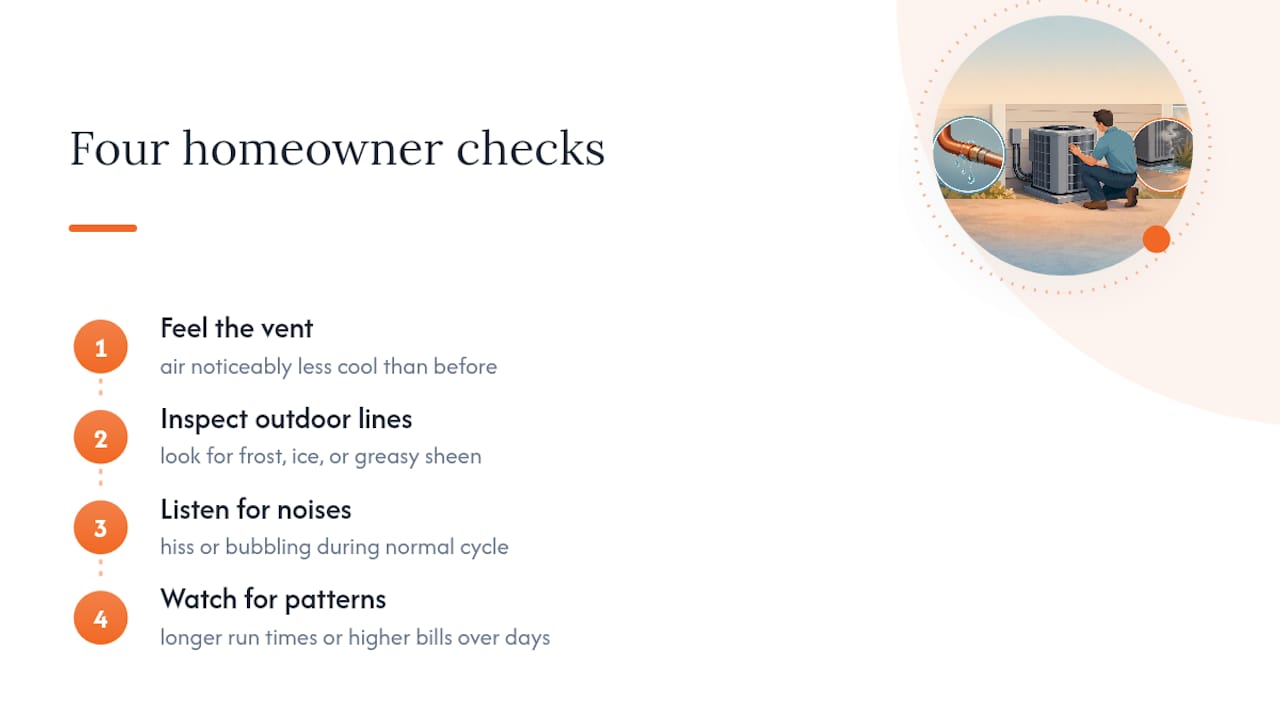
Finally, pay attention to patterns rather than single incidents. One warm afternoon doesn't mean much. A week of longer-than-normal run times, one room that never quite cools like the others, or a utility bill that's noticeably higher than the same month last year adds up to a pattern worth acting on. Catching these early signs before the system loses most of its charge often means a smaller, cheaper repair instead of a coil or compressor replacement.
Do Symptoms Differ by Refrigerant Type?
The core symptoms, warm air, icing, hissing, oily residue, stay consistent no matter what refrigerant your system runs. What changes is how quickly those symptoms show up and what they signal about your equipment's age.
Systems still charged with R-22 tend to show symptoms more gradually, since older equipment was engineered with a wider margin before performance drops noticeably. The catch is that R-22 is a legacy refrigerant with production restrictions, so a significant leak in one of these systems often turns into a conversation about replacement rather than a straightforward recharge.
R-410A systems, common in most homes and light commercial buildings installed over the past two decades, tend to show performance loss faster because they operate at higher pressures. A leak that would take weeks to become obvious in an R-22 system might show up within days on an R-410A unit, particularly during peak summer demand.
Newer, mildly flammable refrigerants used in the latest equipment generally produce the same observable symptoms, but technicians follow additional handling precautions during detection and repair because of that flammability. If your system is only a few years old, mention the model number when you call. It helps the technician bring the right detection equipment and safety gear on the first visit.
Encode's Field Checklist for Reporting a Suspected Leak
When you call, share what you noticed, when it started, and any photos of frost or oily spots. Encode's first visit typically includes a full assessment, a sniff and visual check, and targeted testing before we walk you through repair options and verification steps. Routine maintenance keeps small leaks from turning into expensive emergencies.
— Daniel
Getting Your Leak Diagnosed and Fixed by Encode
For refrigerant leak diagnosis in the Billings area, look for companies offering same-day assessments and EPA-compliant detection and repair that do not rely on simply "topping off" refrigerant. That last part matters more than most homeowners realize, since a proper fix means fewer repeat service calls and a lower total cost over the life of the system.

Encode's technicians run the same staged approach covered above on every call: visual inspection, electronic detection, nitrogen pressure testing when needed, and full post-repair verification before they close out the job. For homeowners dealing with warm air, ice on the coils, or unexplained bills, residential HVAC service covers diagnosis straight through to repair. Facility managers running larger commercial systems can review industrial HVAC support for equipment with bigger refrigerant charges and stricter regulatory timelines.
If you'd rather catch problems before they become emergencies, ask about a maintenance plan that includes routine refrigerant and pressure checks. Call Encode or request service online to get a technician scheduled.
Sources
- What is a leak detector? — Fieldpiece
- HVAC refrigerant leak detection: methods and repair protocols — Air Repair Authority