
Most boiler repairs cost between $150 and $750, with a national average near $450, though major component failures can push a job into the low thousands. Repair is almost always cheaper than replacement, so unless your unit is past 15 years old or you're calling a technician every few months, fix it first. Get a written estimate that itemizes parts and labor before you approve any work.
TL;DR:
- Repairs for common boiler issues typically range from $150 to $750, with central averages around $450, but major parts like heat exchangers can cost over $1,500.
- Cost variations depend heavily on location, fuel type, and the boiler’s age, with gas boilers generally costing less to repair than electric or oil options.
- Repairs during peak winter or emergency after-hours service can add $75 to $150 or more, making off-season appointments more economical.
- When a boiler is over 15 years old or has needed multiple repairs in a single season, replacement may be more cost-effective than fixing repeated issues.
- Getting itemized quotes, performing preventive maintenance, and preparing the boiler area can significantly lower repair costs and extend the system's lifespan.
Table of Contents
- How Much Does Boiler Repair Cost on Average?
- Does Boiler Repair Cost Depend on the Fuel Type?
- What Do Common Boiler Repairs Cost?
- How Are Labor and Service Fees Charged?
- Should You Repair or Replace an Aging Boiler?
- How Can You Lower Your Boiler Repair Bill?
- What Do Technicians Actually Find When They Open Up a Boiler?
- A Technician's Honest Take on Cost, Safety, and Records
- Get a Straight Answer on Your Boiler Repair Cost
- Sources
- FAQ
How Much Does Boiler Repair Cost on Average?
Homeowners calling for a boiler repair typically land somewhere between $150 and $750, with the national average sitting close to $450. That figure covers routine fixes like a stuck pressure valve or a faulty thermostat sensor. It does not cover a full heat exchanger swap or a job that requires draining and refilling the whole system, which can climb into the low thousands once parts, labor, and disposal fees stack up.
Three things move that number more than anything else: where you live, what fuel your boiler burns, and how old the unit is. Labor rates in a major metro area run higher than in a small town. A 25-year-old boiler often needs parts that are harder to source, which adds time and markup to the bill. And a unit that's been skipping annual service tends to arrive at the repair stage with more than one problem at once.
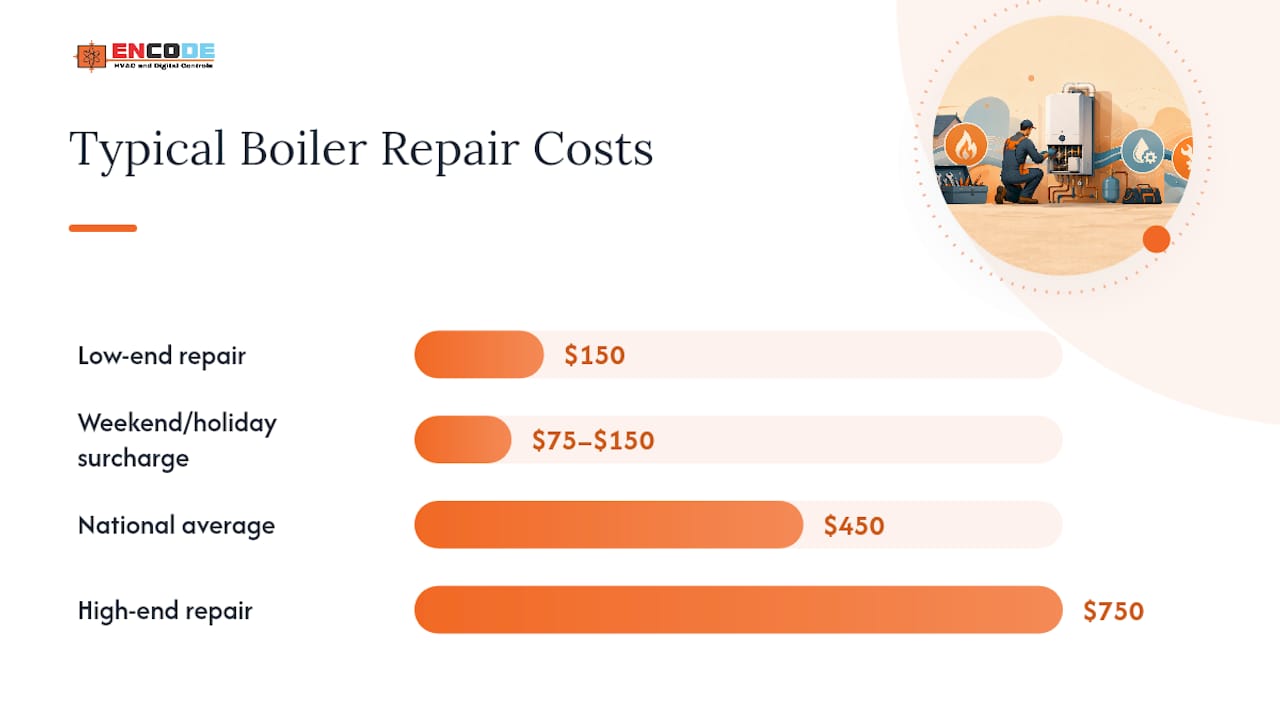
The national average boiler repair bill is approximately $450 — but that number hides a widespread variation depending on timing and the specific failure.
Timing matters more than most people expect:
- Calls placed during the first cold snap of the season, usually late fall, often come with longer wait times and sometimes rush fees.
- Weekend and holiday service visits routinely add $75 to $150 or more on top of standard rates.
- A mid-summer inspection call, when demand is low, is often the cheapest time to get non-urgent repairs handled.
- Emergency after-hours dispatch for a total heating failure in winter carries the highest markup of the year.
Booking service in the off-season, even for a minor issue, is one of the simplest ways to avoid paying a premium for the exact same repair.
Does Boiler Repair Cost Depend on the Fuel Type?
It does, and the gap between fuel types is bigger than most homeowners assume. Gas and propane boilers are the cheapest to fix in most cases, generally $100 to $400 for common repairs, largely because parts are standardized and widely stocked. Gas heating remains the dominant fuel source in American homes, which means technicians see gas systems constantly and keep common components on the truck.
Electric and oil boilers tend to run higher, often $200 to $550 per job. Here's why:
- Electric boilers use specialized heating elements and circuit boards that aren't stocked at every supply house, so parts sometimes have to be special-ordered.
- Oil boilers need periodic nozzle, filter, and pump work that gas systems don't require, and oil-specific technicians are less common in many regions.
- Propane boilers repair similarly to gas in cost, but rural areas with fewer propane techs can see longer wait times, which sometimes translates into higher trip charges.
- Parts lead time varies by fuel type as much as by brand. A common gas ignitor might be on the truck already; an oil-fired burner assembly might take a few days to arrive.
If you're comparing quotes across neighbors or online forums, always check what fuel type their boiler runs before assuming your bid should match theirs.
What Do Common Boiler Repairs Cost?
Estimates get easier to evaluate once you know roughly what each type of repair should run. The table below reflects typical ranges homeowners see on invoices for individual part replacements, not counting labor-heavy jobs that require draining the entire system.
| Repair or Part | Typical Cost Range |
|---|---|
| Ignitor or pilot assembly | $150 to $300 |
| Circulator pump | $300 to $700 |
| Expansion tank | $200 to $550 |
| Zone valve | $200 to $450 |
| Gas valve | $150 to $500 |
| Pressure relief valve | $100 to $200 |
| Minor leak repair (fittings, seals) | $150 to $300 |
| Heat exchanger replacement | $700 to $1,500+ |
Most single-part repairs, an ignitor, a relief valve, a minor leak, stay under $300 in parts and labor combined. The jobs that break $1,000 almost always involve the heat exchanger, extensive corrosion damage, or a circulator pump paired with additional diagnostic time.
A few things quietly inflate a bill beyond the base part cost:
- Corrosion inside the unit often means a technician finds a second failing component once they open the casing, turning a one-part job into two.
- Hard-to-access installations, boilers crammed into tight utility closets or mounted high on a wall, add labor time before any actual repair starts.
- Obsolete parts on boilers older than 15 to 20 years sometimes require custom fabrication or a compatible substitute, both of which cost more than an off-the-shelf replacement.
Pro Tip: Ask your technician to photograph the failed part before it's discarded. If a warranty dispute comes up later, or you want a second opinion on the diagnosis, that photo is worth more than a verbal description.
How Are Labor and Service Fees Charged?
Technicians bill one of two ways: a flat service call fee, typically $150 to $300, or an hourly rate that usually falls between $75 and $150. The flat fee model tends to cover diagnosis plus a straightforward fix; the hourly model shows up more often on complex jobs where the time commitment is harder to predict upfront.
Where the surprises come from:
- After-hours and weekend calls commonly add $75 to $150 on top of the standard rate, sometimes more around holidays.
- Emergency same-day dispatch during a cold spell can double the base service fee depending on how far the technician has to travel and how backed up the schedule is.
- Diagnostics time counts against the hourly rate on trickier failures, so a boiler that's throwing an unclear error code costs more in labor than one with an obvious blown ignitor.
- Access and safety checks add time too. If a technician has to clear a cluttered utility room or verify carbon monoxide levels before touching anything, that's billable time before the actual repair begins.
Always ask whether the quoted number is a flat estimate or a "starting at" hourly figure. The difference matters once a job runs long.
Should You Repair or Replace an Aging Boiler?
A full boiler replacement typically runs into several thousand dollars, an order of magnitude above a single repair bill, which is exactly why repair is the better move in most situations. But not always. Here's a simple way to think it through:
- Check the age. Boilers commonly last 15 to 20 years. If yours is past that window, weigh replacement seriously even for a moderate repair.
- Count the repairs. Two or more paid service calls in a single heating season is a signal the unit is failing systemically, not just hitting one bad part.
- Compare the bill to replacement cost. A widely used rule of thumb: if a single repair quote exceeds roughly 30 to 50% of what a new unit would cost, replacement usually wins long term.
- Ask about efficiency. An older boiler running at lower efficiency costs more every month in fuel, on top of repair bills. That gap alone sometimes justifies replacing early.
Pro Tip: Before you approve a big repair on an older unit, ask your technician for the estimated remaining lifespan of the boiler in writing. A verbal "maybe a few more years" is not the same as a documented assessment you can compare against a replacement quote.
How Can You Lower Your Boiler Repair Bill?
Getting two or three written estimates before approving major work is the single most effective way to avoid overpaying, especially on repairs above $500. Compare not just the total, but what's itemized: parts cost, labor hours, and whether the warranty on the part is 90 days or a full year.
A few other levers worth pulling:
- OEM parts cost more upfront but usually carry longer warranties; aftermarket parts save money now but sometimes fail sooner, which matters on an older unit you plan to keep for years.
- Bundling a repair visit with your annual service call often saves a second trip charge.
- Clearing access to the boiler before the technician arrives, moving storage boxes, unlocking a utility room, shaves real minutes off labor time.
- Homeowners comfortable with basic maintenance can sometimes bleed trapped air from radiators themselves between service visits, which resolves minor circulation noise without a paid call.
Pro Tip: Annual servicing, typically $150 to $500, catches small issues like pressure drift or early scale buildup before they become $700 repairs. It's one of the few maintenance costs that reliably pays for itself.
What Do Technicians Actually Find When They Open Up a Boiler?
Corrosion and scale buildup are the two most common culprits behind repairs that turn out bigger than expected once a technician has the panel open. A heat exchanger that looks fine from the outside can be corroded internally after years without descaling, and that's rarely visible until the unit is disassembled. Obsolete parts on older systems are another frequent surprise, sometimes requiring a compatible substitute rather than an exact replacement.
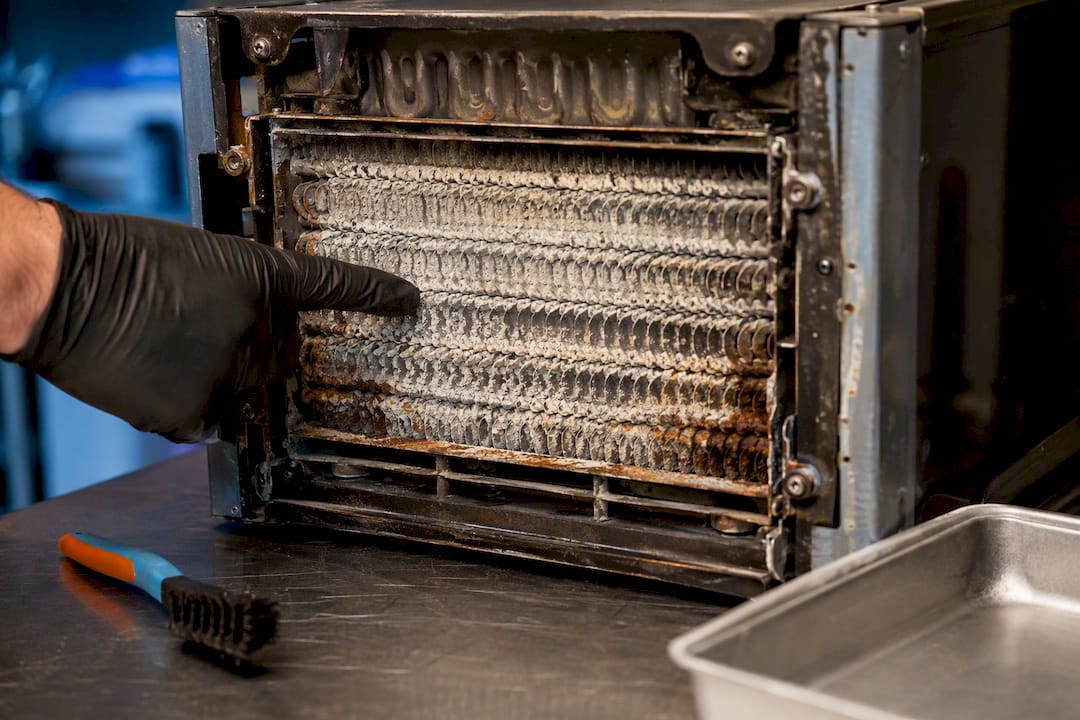
A trustworthy estimate separates parts from labor clearly, so you know exactly what you're paying for before work starts. A trustworthy estimate separates parts from labor clearly, so you know exactly what you're paying for before work starts. Preventative maintenance plans exist for a reason too: catching scale and corrosion early, before they force an emergency repair, is consistently cheaper than waiting for a failure.
A Technician's Honest Take on Cost, Safety, and Records
Cost matters, but it should never come before safety. A suspected gas leak or carbon monoxide concern justifies calling a professional immediately, no exceptions, regardless of what the repair might cost. Beyond that, paying slightly more for a qualified technician upfront usually beats paying twice for a repair redone six months later. One habit pays off longer than people expect: keep every service record. It sharpens future repair estimates and adds real value if you sell the home.
— Daniel
Get a Straight Answer on Your Boiler Repair Cost
You've seen the ranges. What you actually need is someone to look at your specific unit and tell you where your job falls on that spectrum, without vague guesses or upsell pressure. Experienced local HVAC technicians provide straightforward, itemized quotes and fast response times when a boiler fails in the middle of a Montana winter.
Technicians diagnose the actual problem first, then walk you through parts and labor costs before starting work, so you're never surprised by the final invoice. If your boiler has been acting up, or you just want a second opinion on a bid you already received, request a residential HVAC quote and we'll get a technician scheduled. And if repeated repairs are becoming the norm, ask about our maintenance plans, built specifically to catch small issues before they turn into expensive emergency calls.
Sources
- How Much Does It Cost to Repair a Boiler? 2026 Data - Fixr
- How Much Does It Cost to Service or Repair a Boiler? | Angi
- 2026 Boiler Repair Cost: Average Prices & Factors | Thumbtack
- HomeAdvisor boiler pricing guidance
FAQ
How Much Should It Cost to Fix a Boiler?
Most repairs run between $150 and $750, with a national average around $450, though major component failures can exceed $1,500.
What Are the Signs of Boiler Failure?
Watch for inconsistent heating, unusual noises like kettling, visible water leaks, and the unit cycling on and off frequently — all of these warrant a professional inspection.
How Much Is a New Boiler for a 2,000 Square Foot House?
Replacement costs run into the several-thousand-dollar range for a home that size, well above a typical repair bill, which is why replacement usually only makes sense for older or repeatedly failing units.
Is It Worth Repairing a Boiler?
In most cases yes, since repair costs a fraction of replacement. The exception is a unit older than roughly 15 years with frequent breakdowns, where replacement often saves money long term.
How Much Does Annual Boiler Servicing Cost?
Annual maintenance typically costs $150 to $500 and often prevents the costlier repairs that come from neglected pressure and scale issues.