
Your AC is tripping the breaker because it's pulling more current than the circuit can safely carry, usually from restricted airflow, a failing start capacitor, or an electrical fault. Reset the breaker once, check the air filter and outdoor unit, and if it trips again, shut the system off and call a professional.
TL;DR:
- Most AC breaker trips are caused by dirty filters, blocked outdoor coils, or failing start capacitors, which are straightforward to check and fix.
- The timing of a breaker trip—immediate, delayed, or random—indicates specific faults like electrical short circuits or refrigerant problems.
- If the breaker trips again after a reset or if there are signs of burning, smoke, or a hot breaker, you should call a professional immediately.
- Troubleshooting should stop if the system shows obvious mechanical or electrical failures, such as oil leaks or ice buildup, requiring expert diagnosis.
- Regular maintenance, including filter replacements and coil cleaning, can prevent most trips and catch problems early before costly repairs are needed.
Table of Contents
- What Causes an AC to Trip a Circuit Breaker?
- What Can You Safely Check Before Calling for Repair?
- Does the Timing of the Trip Tell You Anything?
- When Should You Stop Troubleshooting and Call a Pro?
- What Do Common Fixes Cost?
- How Do You Stop This From Happening Again?
- What Happens When a Technician Comes Out?
- Why Most Homeowners Get This Diagnosis Backwards
- Get a Trained Technician on the Problem, Not Another Reset
- Sources
What Causes an AC to Trip a Circuit Breaker?
A breaker's job is simple: it interrupts current flow the moment a circuit draws more amps than it's rated for, or when it detects a short circuit or ground fault. That's how circuit breakers work at the mechanical level, whether the load is your AC, a toaster, or a table saw. When your air conditioner trips the panel, something in the system is forcing the compressor or fan motor to work harder than normal, and the extra amp draw crosses the breaker's threshold.
Several things push that draw up:
- Dirty or blocked air filter. Restricted airflow makes the blower motor strain, and it can freeze the evaporator coil. Roughly 40% of AC breaker trips start with a clogged filter, making it the single most common homeowner-fixable cause.
- Dirty condenser coils or a blocked outdoor unit. When the outdoor coil can't dump heat, the compressor works overtime and pulls more current with every cycle.
- A failing start or run capacitor. Capacitors store the electrical punch a compressor needs to start moving. A weak one causes a startup current spike, or a humming compressor that never quite starts.
- Compressor faults. A unit that runs fine for a while, then trips, or one that groans and clunks before shutting off, is often signaling internal compressor trouble.
- Loose wiring, shorts, or a worn breaker. Loose connections generate heat and intermittent trips, and a breaker itself can wear out from age or repeated overload.
- Low refrigerant or an overcharged system. Either extreme forces the compressor to overwork, and you'll often see ice on the copper lines or hear hissing.
Pro Tip: Startup trips almost always point to something electrical: a capacitor or a short. Trips after the system has been running for a while point toward heat buildup: dirty coils, low refrigerant, or a stuck fan.
What Can You Safely Check Before Calling for Repair?
Work through these in order, and stop the moment something looks or smells wrong.
- Reset the breaker once. Flip it fully to OFF, wait 30 seconds, then flip it back ON. One reset is a diagnostic step; a second or third reset is a gamble with your equipment.
- Pull the air filter and hold it up to a light. If light barely gets through, replace it. A filter this dirty is a documented top cause of AC breaker trips.
- Walk out to the outdoor unit and check clearance. Clear leaves, grass clippings, and debris from around the coil. A gentle rinse from a garden hose is fine; never use a pressure washer, which can bend the fins and damage the coil.
- Look for ice, oil spots, or listen for odd noises. Ice on the refrigerant lines suggests airflow or refrigerant problems. Oil spots near fittings suggest a leak. Grinding or clicking suggests a mechanical fault.
- Write down when it trips. Instantly at startup, or 15 minutes into a run, matters more than you'd think for diagnosis.
What you should never touch: the capacitor (it holds a charge that can shock you even with the power off), the disconnect box, refrigerant lines, or the breaker itself. That work belongs to a licensed technician or electrician, full stop.
Does the Timing of the Trip Tell You Anything?
It tells you almost everything. Trip timing is one of the most useful diagnostic clues you can hand a technician before they even arrive.
- Trips the instant the AC kicks on: suspect a failing start capacitor, a seized compressor, or a short circuit somewhere in the unit.
- Trips after 10 to 30 minutes of running: point toward dirty condenser coils, low refrigerant, or a fan motor that's overheating the compressor.
- Only trips on the hottest days: suggests a component that's marginal, aging, or a circuit that's borderline undersized for peak load.
- Trips at random times, along with other household circuits: that's often a panel or wiring issue, not the AC at all.
When Should You Stop Troubleshooting and Call a Pro?
Some signs mean you stop immediately, no second-guessing.
- Burning smell, visible smoke, or scorch marks anywhere near the unit or panel.
- The breaker itself is hot to the touch.
- It trips again immediately after your one reset.
If the symptoms point to the AC unit itself, ice on the lines, a humming compressor, oil residue, call an HVAC technician. If the trips seem tied to panel behavior or other circuits acting up too, call an electrician instead. A technician on site will run a load test, check the capacitor's actual output against its rating, and inspect wiring connections rather than guessing. Loose connections and worn breakers often need load testing to confirm, because swapping the breaker without finding the real fault just delays the next trip.
| Symptom | Likely cause | Who to call |
|---|---|---|
| Trips instantly on startup | Capacitor or short circuit | HVAC technician |
| Trips after 10 to 30 minutes | Dirty coils or low refrigerant | HVAC technician |
| Trips randomly with other circuits | Panel or wiring fault | Electrician |
| Breaker is hot or smells of burning | Electrical fault, urgent | Electrician (immediately) |
What Do Common Fixes Cost?
Costs vary by market and system size, but the pattern is consistent: the earlier you catch the problem, the cheaper the fix.
- Filter replacement and coil cleaning are the cheapest fixes and resolve a large share of trips before they become anything worse.
- Capacitor replacement is a common mid-range repair, usually triggered by humming, slow starts, or a compressor that won't kick on.
- Contactor or fan motor repair falls into a similar range and is urgent if the fan has stopped moving air across the coil.
- Refrigerant leak diagnosis and repair costs more and requires an EPA-certified technician, since refrigerant handling is federally regulated.
- Compressor replacement or a full system swap is the most expensive outcome, typically reserved for units that are older or have suffered repeated electrical stress, making proper planning critical as detailed in this commercial HVAC upgrade guide.
- Breaker or panel work falls to an electrician and depends on whether it's a simple breaker swap or a wiring repair.
How Do You Stop This From Happening Again?
Prevention here isn't complicated. It's mostly a matter of keeping up with a few habits.
- Replace or check the filter every 30 days during heavy cooling season, more often if you have pets or run the system constantly.
- Book an annual tune-up that includes amp draw testing, tightening electrical connections, coil cleaning, and a refrigerant check.
- Keep at least two feet of clearance around the outdoor unit, and trim back vegetation that crowds the coil.
- Keep interior vents open and set your thermostat fan to "auto" rather than constantly cycling the system on extreme settings.
- Consider a maintenance plan that catches a weakening capacitor or a slow refrigerant leak before either one causes a trip.
Pro Tip: A capacitor rarely fails without warning signs first, usually a slower start or a faint hum. Catching that in an annual tune-up is far cheaper than replacing a compressor it eventually strains to death.
Encode Corporation's maintenance plans and guidance on how often HVAC systems should be serviced in Montana both center on this same idea: catching small problems before they trip a breaker or take down a compressor.
What Happens When a Technician Comes Out?
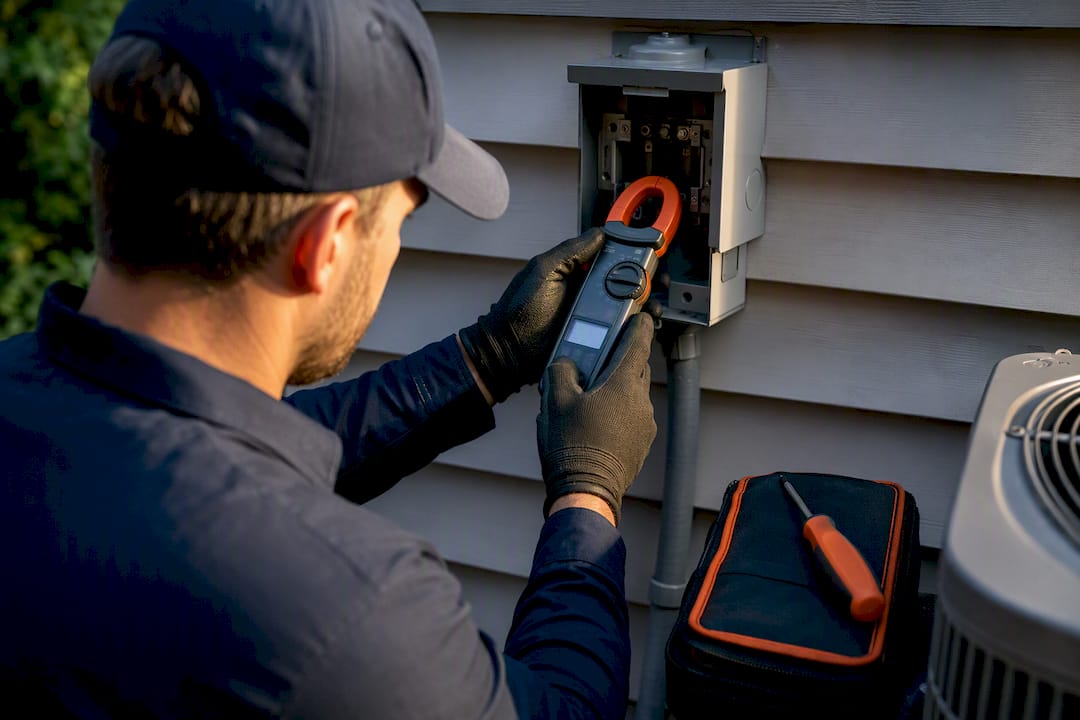
A trained technician doesn't guess. The visit typically includes a safety lockout of the unit, amp and start-current measurements, a capacitor load test, a wiring inspection for loose or overheated connections, and a check for refrigerant leaks. Encode Corporation has handled these diagnostics across Billings and the surrounding area for more than 40 years, and technicians and electricians often coordinate directly when a trip turns out to be a panel issue rather than an AC fault. That collaboration, and the training behind it, is exactly why capacitor testing and wiring work aren't DIY jobs.
Why Most Homeowners Get This Diagnosis Backwards
Most advice online treats a tripping breaker as an electrical mystery to be solved with more resets. That instinct is exactly backwards. A breaker tripping is the system telling you something specific, and the timing of that trip is more diagnostic than most homeowners realize. An instant trip and a trip after twenty minutes point to almost entirely different failures, yet both get treated the same way in a lot of troubleshooting guides: reset and hope.
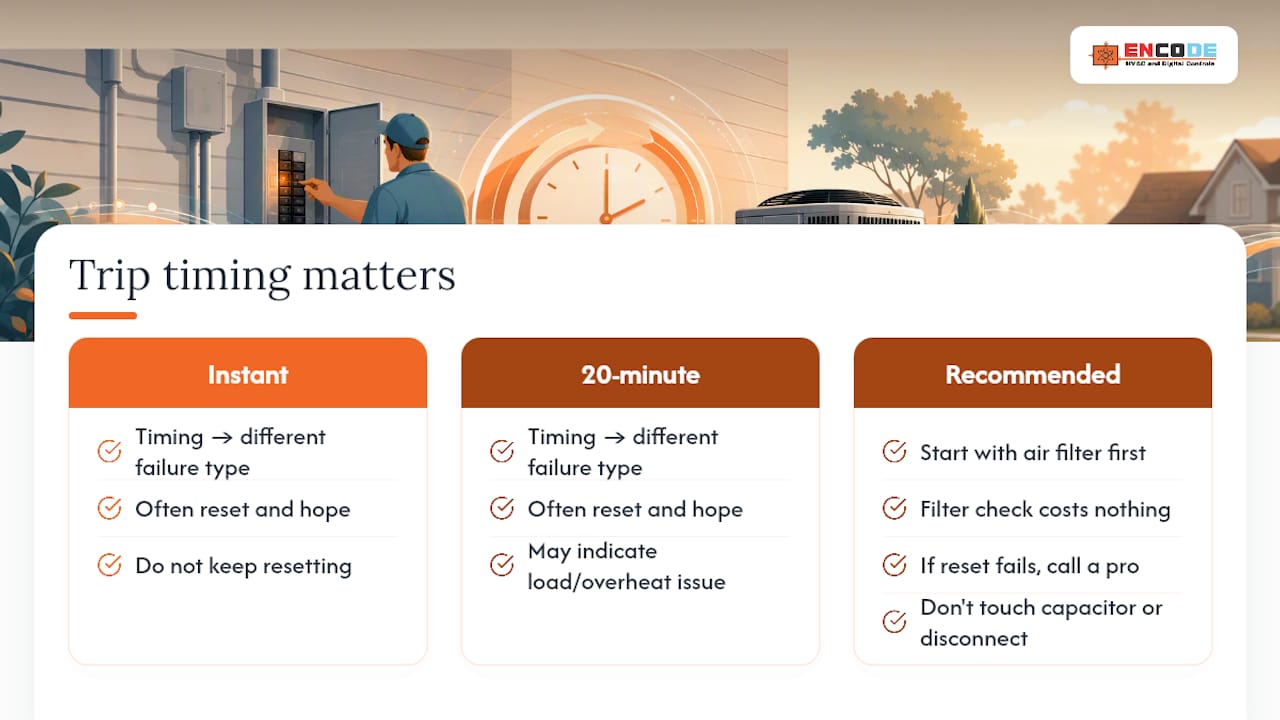
The bigger blind spot is how often people underestimate the filter. It sounds too simple to be the real answer, so homeowners skip past it looking for something more dramatic, a bad compressor, a wiring nightmare, and burn a service call finding out their filter was clogged solid. Start there every time. It costs nothing and rules out the most common cause in minutes.
Where conventional advice really fails is safety. A lot of DIY guides walk readers right up to the capacitor and the disconnect box without stopping them. That's not troubleshooting. That's a shock risk dressed up as a repair tip. If your one reset doesn't hold, the smartest move isn't a second reset. It's a phone call.
— Daniel
Get a Trained Technician on the Problem, Not Another Reset
If you've reset the breaker once, checked the filter, and cleared debris from the outdoor unit and the AC still trips, it's time to stop guessing and get eyes on the actual electrical load. Professional HVAC providers have been diagnosing exactly this problem for many years, with the response speed to get a technician out before a minor capacitor issue turns into a failed compressor.

Unlike a one-size troubleshooting checklist, a technician brings load-testing equipment that shows the actual amp draw against your breaker's rating, along with a capacitor tester that confirms in minutes what a homeowner can only guess at from symptoms. Encode's residential HVAC services cover exactly this kind of diagnostic repair, and if the trips turn out to be tied to your home's electrical panel rather than the AC itself, Encode's technicians know when to bring in an electrician instead of guessing through it. If your system keeps tripping after the basic checks, book a diagnostic visit and get a straight answer instead of another breaker reset.
Sources
- AC Breaker Keeps Tripping? Complete Troubleshooting Guide 2026
- Electronics
- AC Breaker Tripping? Troubleshooting Guide | On Point Service Company