
If your AC running constantly is happening on a mild day or the house still isn't cool, the fix is usually a $0 to $30 problem: the thermostat fan is set to ON, the setpoint is too low, or the filter is clogged and choking airflow. Serious causes look different: a stuck contactor, a refrigerant leak, or a frozen evaporator coil. If the home won't cool down or the outdoor unit refuses to shut off, cut power at the breaker and call a technician before anything else.
TL;DR:
- Most cases of constant AC running on mild days are caused by thermostat fan settings, low setpoints, or clogged filters, which are simple to fix yourself.
- Prolonged running without reaching the setpoint is normal during hot weather if the system maintains comfort and humidity; issues arise when the house stays warm or short cycles occur.
- Common mechanical causes include dirty or frozen coils, low refrigerant, or stuck contactors, all requiring professional intervention for proper diagnosis and repair.
- Regular maintenance, such as filter replacement every 30 to 90 days and annual tune-ups, can prevent most overworking issues and extend system lifespan.
- Immediate technician assistance is necessary when the outdoor unit runs constantly with the thermostat off, if odd noises or ice appears, or if breaker trips persist after resets.
Table of Contents
- AC Running Constantly? Try These Checks First
- Is Long Runtime Normal or a Sign of Trouble?
- What's Actually Causing the System to Overwork?
- Maintenance That Keeps Runtime Normal
- What Happens During a Technician Visit?
- Could the Wrong Size Unit Be to Blame?
- Are Your Ducts Working Against Your AC?
- Daniel's Take: Know Where the DIY Line Is
- Get Same-Day Help From Encode Corporation
- Sources
- FAQ
AC Running Constantly? Try These Checks First
Before assuming the worst, walk through these checks in order. Most take less than two minutes each, and together they solve the majority of "why won't my AC turn off" calls that service technicians get in a typical week.
- Check the thermostat mode and fan setting. Confirm it's set to COOL, not FAN ON. A fan switched to ON runs the blower nonstop even when the compressor cycles normally, and flipping it to AUTO is a very common fix for what feels like nonstop running.
- Check the setpoint. If someone bumped the target temperature down to 65 on a 95 degree day, the system will run for hours trying to catch up. Raise it a few degrees and watch what happens.
- Check the batteries and schedule. A dying thermostat battery or a leftover vacation schedule can quietly override your normal settings.
- Pull the air filter and hold it up to a light. If you can't see light through it, it's blocking airflow and needs to be replaced. Most homes need a new filter every 30 to 90 days depending on pets, dust, and filter type.
- Walk the house and check registers. Open any closed supply vents, move furniture blocking returns, and check for shut dampers in unused rooms.
- Look at the outdoor unit. Clear leaves, grass clippings, or mulch piled against the cabinet, and make sure the fan on top spins freely. Do not remove any access panels. That's high-voltage territory.
- Locate the breaker. If you suspect an electrical trip, you can safely flip it off and back on once. If it trips again immediately, stop and call a technician.
Pro Tip: Snap a photo of your filter's size and MERV rating with your phone before you toss the old one. It saves a trip back to the store when you're standing in the HVAC aisle guessing.
Is Long Runtime Normal or a Sign of Trouble?
A system that runs most of the afternoon on a 98 degree day isn't necessarily broken. Continuous operation is not automatically a fault. If the house holds its setpoint, everyone's comfortable, and humidity feels controlled, that long runtime can be completely normal, especially for a properly sized system or a variable-capacity unit designed to run longer at lower output instead of blasting on and off.
The picture changes when the house never actually reaches the setpoint, no matter how long the system runs. Watch for these warning signs:
- The indoor temperature stalls a few degrees above your setpoint for hours
- Short cycling, where the system turns on and off every few minutes instead of running a steady cycle
- Visible ice or frost on the indoor coil or refrigerant lines
- Grinding, squealing, or clicking noises that weren't there before
- The breaker trips more than once
- Your energy bill jumps without a matching stretch of extreme heat
Before calling anyone, ask yourself three questions: Is the house actually cooling, even slowly? Has the outdoor temperature been unusually extreme? Did this start suddenly or has it been building for weeks? Your answers point straight to whether this is a maintenance issue or an emergency.
What's Actually Causing the System to Overwork?
Several mechanical and electrical failures share a common symptom: the system runs and runs but never quite finishes the job. Here's what's likely happening underneath.
A dirty or frozen evaporator coil is one of the most common culprits. Dirt buildup on this coil can cut cooling capacity by 20% to 40%, forcing the system to run far longer to reach the same setpoint. If you see frost or ice, switch the system off and set the fan to run alone so it can thaw. Never run the compressor with a frozen coil. Cleaning the coil itself is a technician job, since it usually requires disassembling part of the indoor unit.
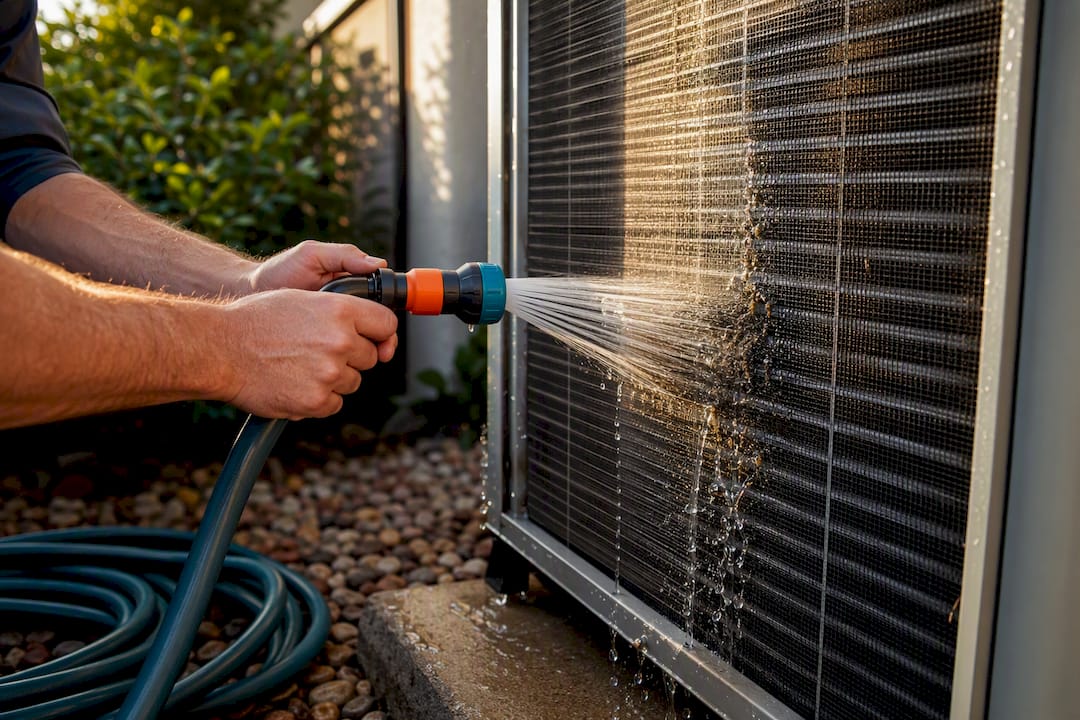
A dirty condenser coil outside behaves the same way in reverse. Grime on those outdoor fins can raise compressor energy use by roughly 20% to 30%, because the unit struggles to dump heat outside. This is one of the few coil issues a homeowner can partly prevent just by hosing off visible debris and keeping plants trimmed back.
Low refrigerant or a slow leak shows up as a system that runs constantly but never cools well. Refrigerant doesn't get "used up" like fuel. If the level is low, something is leaking, and that requires professional leak detection and a recharge.
A stuck contactor or relay is an electrical fault where the outdoor compressor keeps running even after the thermostat shuts off, sometimes with welded contacts stuck closed. This is a cut power and call a technician situation, full stop.
A struggling blower motor or leaky ductwork starves the system of airflow, stretching every cooling cycle longer than it should be.
| Cause | What you'll notice | Fix required |
|---|---|---|
| Dirty/frozen evaporator coil | Weak cooling, ice on coil or lines | Thaw safely, then professional cleaning |
| Dirty condenser coil | Outdoor unit runs harder, higher bills | Clear debris, technician deep clean |
| Low refrigerant | Runs constantly, poor cooling | Leak detection and recharge |
| Stuck contactor/relay | Outdoor unit runs with thermostat off | Cut power, call technician immediately |
| Blower motor or duct losses | Weak airflow, longer cycles | Motor service or duct sealing |
Maintenance That Keeps Runtime Normal
Most of the failures above are preventable with a handful of habits.
- Replace the filter on a schedule, not when it looks bad. Every 30 to 90 days is typical, and a dirty filter alone can drag system efficiency down by up to 15%.
- Book an annual professional tune-up. A real inspection covers coil cleaning, refrigerant pressure checks, electrical connections, and airflow measurement, catching small issues before they turn into a Saturday afternoon breakdown.
- Keep 2 to 3 feet of clearance around the outdoor unit. Shrubs, fences, and stacked firewood all restrict airflow the condenser needs to shed heat.
- Check thermostat placement. A thermostat near a sunny window, a heat vent, or the kitchen reads the room wrong and calls for cooling the house doesn't actually need.
- Consider a programmable or smart thermostat if you're still working off a manual dial. Consistent scheduling avoids the wide setpoint swings that force a system to run flat out to catch up.
Pro Tip: Write the filter size on your calendar with a recurring reminder. It's the single easiest habit that prevents a service call. A regular service schedule catches most of these problems before they become an emergency, and an ongoing maintenance plan builds that schedule in automatically instead of relying on memory.
What Happens During a Technician Visit?
A proper diagnostic visit follows a fairly predictable order, and knowing it helps you evaluate whether a quote makes sense. A technician typically starts by observing the system run through a full cycle, then checks airflow at the vents, tests refrigerant pressures, inspects the contactor and relay, and finally examines the coils for buildup or ice.
Repair costs vary by system and region, but rough ranges look like this:
- Thermostat replacement: $110 to $300
- Contactor or relay replacement: $150 to $450
- Control board replacement: $400 to $650
Replacement starts making more financial sense than repair once the compressor fails outright, the system is past 12 to 15 years old, or you're calling for a major repair every year or two.
Some symptoms mean stop what you're doing and call immediately: a burning smell from any vent or the outdoor unit, a breaker that keeps tripping no matter how many times you reset it, or an outdoor unit running with the thermostat switched off. Cut power at the breaker in all three cases and don't wait for a "maybe it'll stop."
Could the Wrong Size Unit Be to Blame?
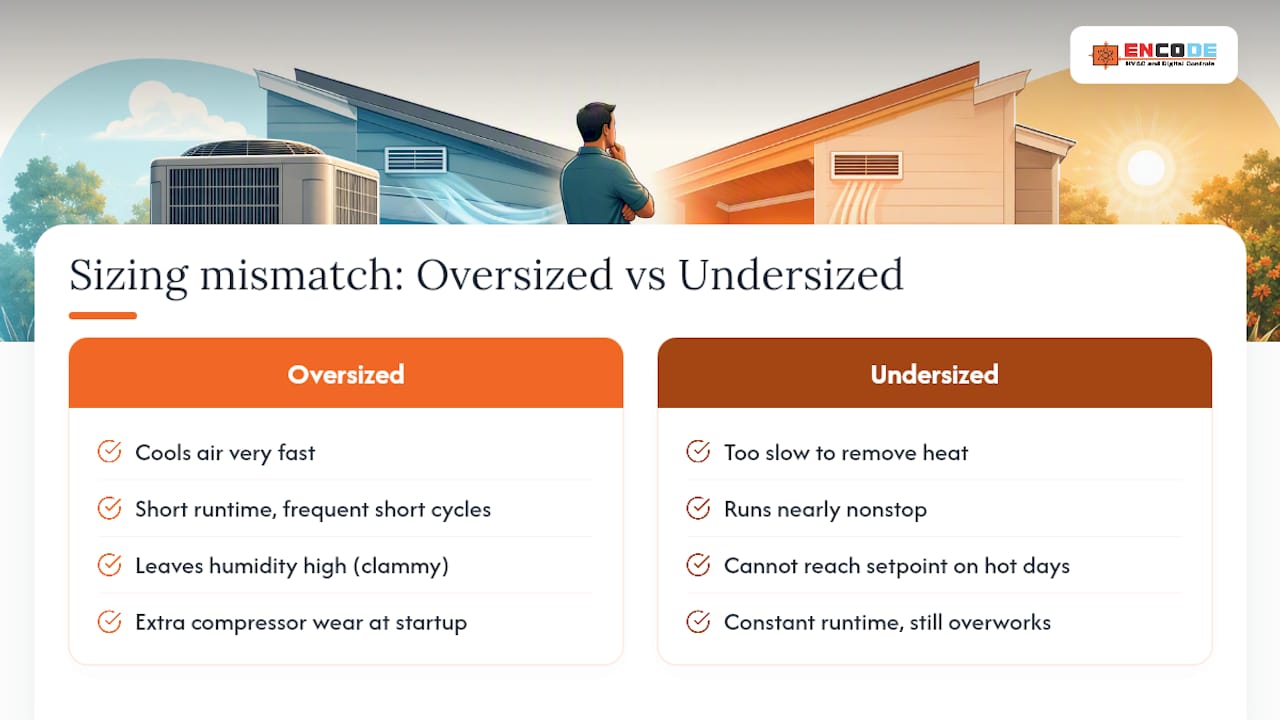
An oversized air conditioner cools the air fast, then shuts off before it has time to pull humidity out of the house. That leaves the air clammy even though the thermostat says the target temperature was hit, so the system short cycles constantly, chasing a comfort level it never truly reaches. Each start up also puts extra wear on the compressor, since the heaviest electrical draw happens right at startup.
An undersized unit has the opposite problem. It's simply too small to remove heat as fast as the house gains it on a hot afternoon, so it runs nearly nonstop and still can't hit the setpoint. That's the classic AC unit overworking scenario, and no amount of filter changes or coil cleaning will fix a fundamental capacity mismatch.
Sizing depends on square footage, insulation quality, window orientation, ceiling height, and local climate, which is why an online BTU calculator often gets it wrong for an unusual layout or an older, leakier home. A proper load calculation accounts for all of it. If your system was installed by a previous owner, a contractor working from a rough estimate, or as a same-day emergency swap without a real calculation, sizing is worth investigating before you spend more money chasing symptoms that a filter change won't solve.
Are Your Ducts Working Against Your AC?
Leaky or poorly insulated ductwork forces your system to produce more cooling than the house actually needs, because a chunk of that cooled air never makes it to the rooms it was meant for. Air escaping through a gap in the attic or crawlspace is air your system has to make up for by running longer.
Poor insulation adds a second penalty. Ducts running through a hot attic pick up heat on the way to your vents, so the air arriving at the register is measurably warmer than the air that just left the unit. The system compensates by running longer to hit the same setpoint, and your energy bill absorbs the difference.
Signs of duct trouble include rooms that never feel as cool as others, a musty smell when the system runs, visible gaps or disconnected sections in accessible duct runs, and ducts that feel warm to the touch in summer. Regular duct inspection and cleaning catches blockages and buildup before they choke off airflow entirely, and sealing obvious leaks is one of the more overlooked ways to cut runtime without touching the equipment itself. If a full duct evaluation feels beyond a DIY afternoon, it's worth folding into the same visit as a coil cleaning or refrigerant check, since a technician is already on site with the tools to test airflow properly.
Daniel's Take: Know Where the DIY Line Is
Most calls we get turn out to be a filter or a fan switch left on ON, and that's a genuinely good outcome. Others need a fifteen dollar contactor swapped out before it welds shut and takes the compressor with it. The pattern holds after 40-plus years in Montana HVAC: do the free checks first, but the moment refrigerant or live electrical components are involved, that's a licensed technician's job, not a weekend project.
— Daniel
Get Same-Day Help From Encode Corporation
If you've run through the filter, fan, and breaker checks and the system is still running nonstop, it's time for a professional set of eyes. Professional HVAC technicians handle residential AC diagnostics, refrigerant checks, and control troubleshooting with rapid response times, so you're not left waiting for service during hot weather.

A typical visit starts with the same diagnostic flow covered above: airflow test, refrigerant pressure check, and an inspection of the contactor and coils, so you get a straight answer instead of a guess. If your system is a repeat offender, our residential HVAC service team can also set you up on a maintenance plan that catches these issues before they turn into a hot afternoon emergency. Call Encode Corporation today to book a diagnostic visit and get your cooling back on a normal cycle.
Sources
This article draws on maintenance and efficiency guidance from the U.S. Department of Energy and its home cooling tips, along with practical diagnostic frameworks from Green Building Advisor and InspectApedia for symptom checklists and safety steps.
- Is it bad when the air conditioner runs a lot? | Green Building Advisor
- A/C or heat pump never stops | InspectApedia
FAQ
Why Does My AC Run All Day Without Shutting Off?
The most common causes are a thermostat fan stuck on ON, a setpoint that's too low, a dirty filter blocking airflow, or extreme outdoor heat pushing a properly sized system to its limit.
Is It Bad for My AC to Run Constantly?
Not necessarily. If the house holds its setpoint and stays comfortable, long runtime can be normal, but if the house never cools down or you hear odd noises, it points to a real fault.
Why Does My Outdoor AC Unit Never Turn Off, Even With the Thermostat Off?
This usually means a stuck or welded contactor is keeping the compressor circuit closed regardless of thermostat signal. Cut power at the breaker and call a technician right away.
How Often Should I Change My AC Filter to Prevent Constant Running?
Every 30 to 90 days depending on pets, dust, and filter type.
When Should I Call a Technician Instead of Troubleshooting Myself?
Call immediately if you smell burning, the breaker keeps tripping, the outdoor unit runs with the thermostat off, or you see ice on the coil or lines. Encode Corporation's controls service team can also help when the issue traces back to thermostat wiring or control faults.