
If your AC won't turn on, the most likely causes are power related: a tripped breaker, a disengaged outdoor disconnect, dead thermostat batteries, or a condensate safety switch that's shut the system down on purpose. Run the five minute checklist below before you call anyone. If the breaker keeps tripping, or you hear humming without the fan moving, stop touching things and call an HVAC technician.
TL;DR:
- A tripped double-pole breaker or blown fuse are common power issues that often resolve with a simple reset or replacement, but repeated trips suggest an underlying electrical fault.
- A clogged or frozen condensate drain, dirty filter, or safety switch can cause system shutdowns, and clearing these often restores AC operation without professional help.
- Dead thermostat batteries or incorrect settings usually prevent signals from reaching the outdoor unit, making a basic thermostat check and battery replacement crucial first steps.
- Symptoms like humming noises, rapid clicking, or ice buildup indicate faulty capacitors, contactors, or refrigerant leaks requiring professional diagnosis and repair.
- Ignoring signs such as water pooling, ice inside the unit, or persistent humming can lead to compressor failure, so timely professional inspection is essential.
Table of Contents
- Ac Not Turning On: Quick Checklist To Run First
- How Do You Know If It's A Power Problem?
- Why Isn't The Thermostat Sending A Signal?
- Could Airflow Or A Clogged Drain Be The Cause?
- What Does A Failing Capacitor Or Contactor Sound Like?
- Could The Compressor Or Refrigerant Be The Real Problem?
- What Should You Never Do When The AC Won't Start?
- When Should You Call An HVAC Technician?
- Encode's Field Perspective On No-Start Calls
- Get A Fast, Local Fix Instead Of Guessing At One
- Sources
Ac Not Turning On: Quick Checklist To Run First
Work through these in order. Most no-start calls get solved somewhere in the first three steps, and you don't need any tools.
- Set the thermostat to Cool and drop the setpoint several degrees below room temperature. If the display is blank, swap the batteries before doing anything else.
- Go to your main electrical panel and find the AC breaker. If it sits in the middle, it's tripped. Flip it fully off, then on, once.
- Walk to the outdoor unit and check the disconnect box mounted on the wall beside it. Make sure the pull block or lever is fully seated.
- Pull your indoor air filter and hold it up to a light. Replace it if you can't see through it, and glance at the condensate pan for standing water or a raised float switch.
- Clear leaves, grass clippings, or ice from around the outdoor condenser, and press the unit's reset button if it has one.
Pro Tip: Write down what happened at each step before you call for service. "Breaker tripped once, reset fine, unit still silent" tells a technician more in five seconds than "it's just not working."
This same five-check sequence is what resolves a large share of no-start service calls before a technician even gets involved, according to HomeFixer101's troubleshooting breakdown.
How Do You Know If It's A Power Problem?
A double-pole AC breaker that's tripped usually sits in a middle position, neither fully up nor fully down. Reset it with a clean off, then on. If it holds, you're done. If it trips again immediately, stop. That's not a fluke. A breaker that won't hold usually means the compressor or another component is drawing too much current, and repeated resets can lead to fire or compressor damage rather than fixing anything.
The outdoor disconnect is the gray metal box mounted on the wall next to your condenser. It holds either a pull-out fuse block or a lever switch, and its job is to let a technician cut power without walking back to the main panel. You can visually confirm it's pushed in or flipped on, but don't open it further than that. If it's a fuse-based disconnect and a fuse has visibly blown (a dark, cloudy window on the fuse), that's a straightforward homeowner swap with a same-amperage replacement. If you're not sure what amperage it needs, or the box looks scorched, treat that as pro territory.
Here's where a lot of homeowners get into trouble: they treat a tripped breaker like a light switch. It isn't.
- One reset is diagnostic. A second immediate trip is a warning sign, not bad luck.
- A blown fuse you can identify and match is fine to replace yourself.
- Burning smells, melted insulation, or a breaker that's warm to the touch means power off at the main and call a professional immediately.
- Outdoor disconnects that spark, buzz, or feel loose need an electrician or HVAC tech, not a screwdriver.
Carrier's own troubleshooting guidance lists breaker trips, blown fuses, and incorrect thermostat settings as the most common reasons a unit won't start at all, which is exactly why this is the first place to look, not the last.
Why Isn't The Thermostat Sending A Signal?
Your thermostat is the brain telling the outdoor unit when to run, and a surprising number of "broken AC" calls turn out to be a brain that's simply asleep. Confirm the mode is set to Cool, not Off, Heat, or Auto-only with a bad schedule, and that the setpoint is at least a couple of degrees below the current room temperature. Dead batteries are common enough that it's worth keeping a spare set on hand near the unit.
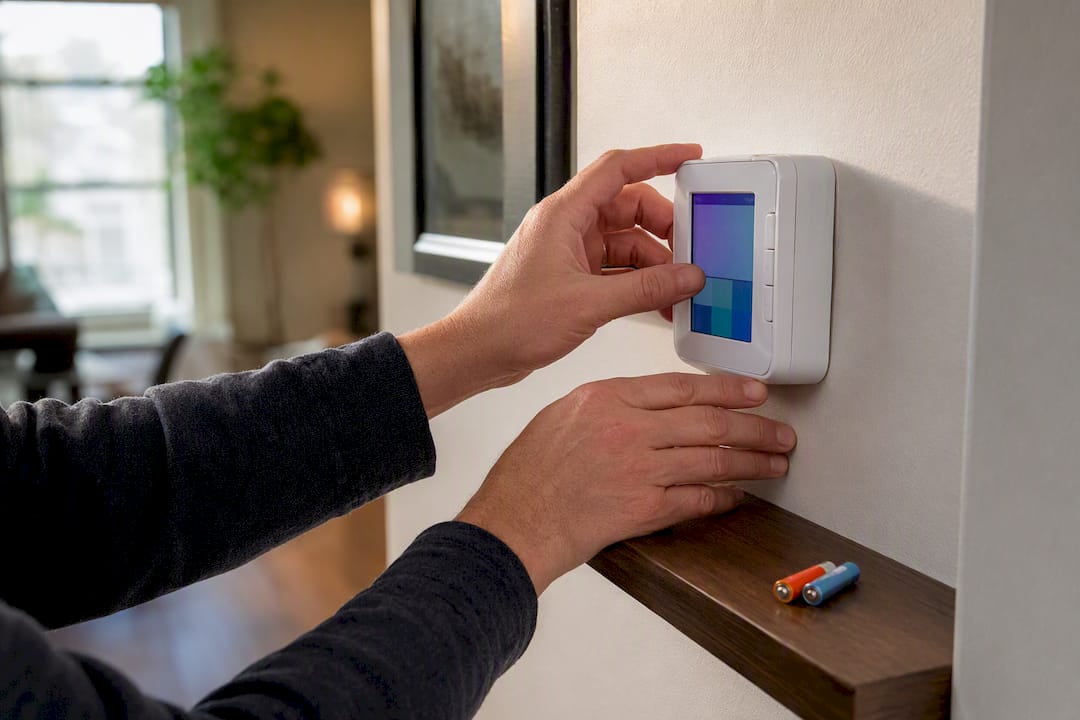
To tell if the thermostat is actually calling for cooling, listen for the indoor blower kicking on within a minute of adjusting the setpoint. If the blower runs but the outdoor unit never responds, that points away from the thermostat and toward the outdoor unit or its wiring. If nothing happens indoors either, the thermostat itself, or the low-voltage wiring feeding it, is the suspect.
Smart thermostats add another layer worth checking:
- Open the app and confirm it shows the system online and actually connected to the Wi-Fi bridge, not just powered.
- Check for a schedule or "hold" setting that's silently overriding your manual adjustment.
- Try a basic thermostat reset (removing it from its base for 30 seconds often works) before assuming hardware failure.
- If the thermostat display is blank even with fresh batteries, or the screen flickers, a transformer or wiring fault is likely, and that's a job for a technician with a multimeter.
Could Airflow Or A Clogged Drain Be The Cause?
A dirty filter does more damage than most people realize. It starves the system of airflow, which can ice up the evaporator coil and, in many units, trip a safety switch that shuts the whole system down before you ever notice ice. Pulling and replacing that filter is often the single fix that gets a "dead" AC running again, and manufacturers including Trane recommend checking it regularly as part of normal upkeep.
The condensate drain is the other half of this problem, and it's the one homeowners overlook most. Somewhere near your indoor air handler is a drain pan with a float switch sitting in it. When the drain line clogs and water backs up, that float rises and cuts power to the whole system on purpose, a safety feature, not a malfunction. This Old House's troubleshooting guide points to this exact mechanism as a frequent, fixable cause of a no-start AC.
- Find the drain pan (usually near the furnace or air handler) and check for standing water.
- If the float switch is raised, that's your answer. Clear the drain line with a wet/dry vac at the outdoor termination point if you're comfortable doing so.
- Look at the outdoor coil and indoor evaporator coil for visible ice. If you see frost, turn the system off entirely and let it thaw for several hours. Running a frozen system risks compressor damage.
- If the drain clogs repeatedly or the coil keeps icing, schedule a maintenance visit rather than clearing it yourself every few weeks.
Pro Tip: A wet/dry vacuum on the outdoor end of the condensate line will pull most clogs free in under a minute. Skip the compressed air, it can push the clog deeper instead of out.
What Does A Failing Capacitor Or Contactor Sound Like?
If you walk outside and hear a persistent hum or a rapid clicking but the fan blade never moves, that's the classic signature of a failed start capacitor or a stuck contactor, not a power problem. Short-cycling, where the unit kicks on for a few seconds and shuts off again, points the same direction and shouldn't be ignored, since running a short-cycling system repeatedly raises the risk of compressor failure and a much bigger repair bill.
These symptoms are useful for diagnosis. They are not an invitation to open the panel yourself.
- Humming with no fan movement usually means the capacitor has failed or the fan motor is seized.
- Rapid clicking without a start typically points to a bad contactor not pulling in properly.
- A fan that spins fine if nudged by hand (for diagnosis only, never do this with power on) confirms a capacitor issue.
- Any of these symptoms means power off, then call a technician, not a screwdriver and a multimeter.
Start capacitors store a genuinely dangerous electrical charge even after the unit is switched off, which is why technicians carry discharge tools before they'll touch one. A capacitor and contactor replacement is a common repair in HVAC and can often be completed relatively quickly on a service call, but the voltage risk is real enough that it's not a reasonable DIY project regardless of your comfort with tools.
Could The Compressor Or Refrigerant Be The Real Problem?
If you've worked through power, thermostat, airflow, and drain issues and the unit still won't start, or it tries to start and immediately shuts back off, refrigerant or compressor failure moves to the top of the list. This is also the category This Old House flags as requiring a licensed technician, since refrigerant handling falls under EPA regulation and isn't legal or safe for homeowners to touch.
- Ice on the refrigerant lines, warm air where cool should be, or a hissing sound near the unit all suggest a refrigerant leak.
- A compressor that hums, attempts to start, then locks out is often protecting itself from an internal fault.
- Diagnosing either requires refrigerant gauges and electrical test equipment a homeowner won't have on hand.
- Compressor replacement is a significant repair, often one of the costlier line items in residential HVAC work, and it's worth getting a second opinion before authorizing it.
ACs that fail to start and those that run but fail to cool require different diagnostic approaches. HomeFixer101 draws this distinction clearly: no-start problems are almost always power or control related, while a running-but-not-cooling system usually points toward refrigerant or airflow.
What Should You Never Do When The AC Won't Start?
A few mistakes turn a simple no-start into an expensive one, or a dangerous one.
- Never open the outdoor electrical compartment or touch a capacitor. It can hold a charge strong enough to injure you even with the unit unplugged.
- Never hose down the outdoor unit while it's connected to power, even to clear debris.
- Never reset a tripped breaker more than once. A second trip means a real fault, not bad luck.
- If you smell burning, see smoke, or notice sparking anywhere near the unit or panel, cut power at the main breaker immediately and call for help.
A breaker that trips a second time after a single reset is telling you something specific: current draw or insulation resistance has failed somewhere in the system. That's a job for a meter and training, not persistence.
While you wait for service, leave the indoor blower fan running if it still works, since that keeps some air moving through the house. Snap a few photos of anything unusual, including breaker position, ice on the coil, or standing water, and jot down what you noticed and when.
When Should You Call An HVAC Technician?
Certain symptoms mean you're done troubleshooting and it's time to make the call: a breaker that trips a second time, humming with no fan movement, any burning smell, visible ice on the coil, water pooling near the air handler, or hissing near the refrigerant lines.
Before you dial, gather a few details that speed up the visit considerably:
- Your system's brand, model, and approximate age.
- What you noticed and when it started, plus the results of your own checklist.
- Any photos of ice, water, or the breaker position.
- Your last maintenance or filter-change date, if you know it.
| What the technician checks | What it tells them |
|---|---|
| Voltage at the disconnect and breaker | Confirms power is actually reaching the unit |
| Capacitor and contactor condition | Identifies failed start components |
| Refrigerant pressures | Reveals leaks or compressor strain |
| Condensate line and float switch | Confirms drain-related safety shutoffs |
| Low-voltage thermostat wiring | Rules out control signal faults |
A standard diagnostic visit is usually far less expensive than a compressor replacement, which is exactly why catching problems at the capacitor or drain stage instead of letting them progress is worth the service call.
Encode's Field Perspective On No-Start Calls
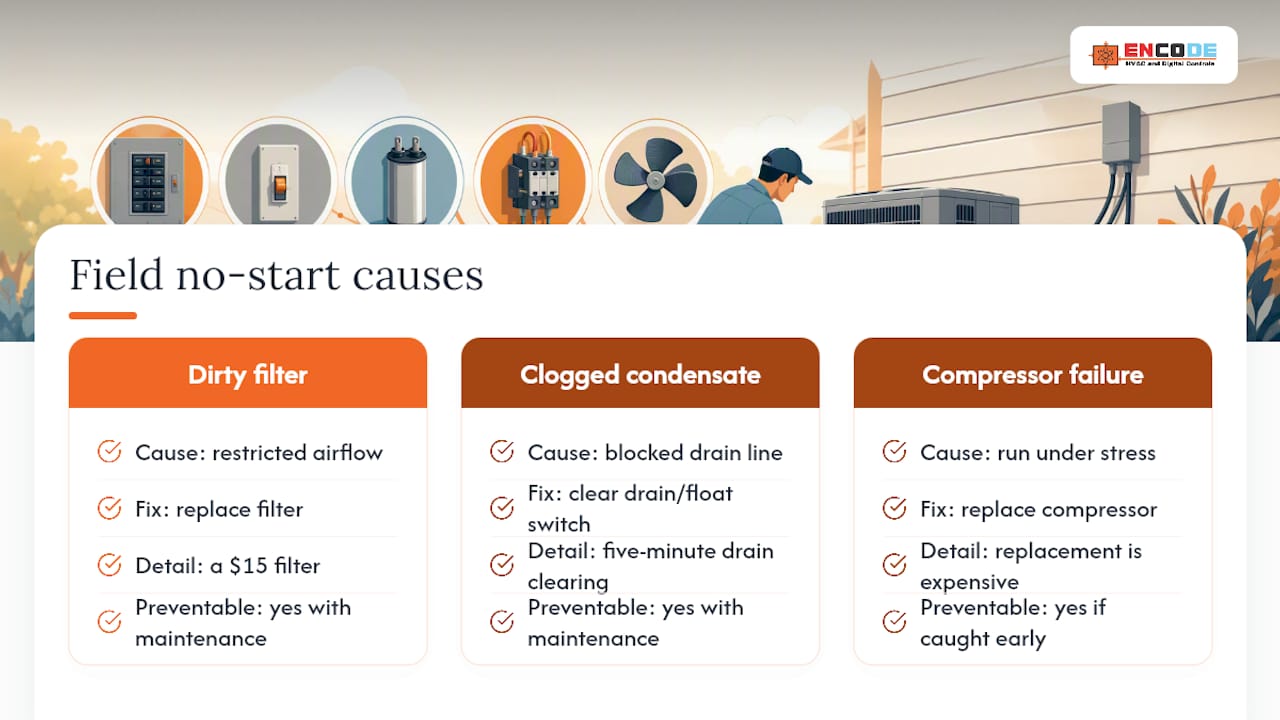
Most urgent "AC won't turn on" calls Encode Corporation gets during Montana's peak cooling months trace back to the same two culprits: a filter nobody changed in months, or a condensate line that clogged quietly until the float switch did its job. Neither is dramatic. Both are entirely preventable.
What surprises homeowners is how often a $15 filter or a five-minute drain clearing stands between a working system and an emergency call on the hottest day of the year. Catching a struggling compressor early, before it's tripping breakers or locking out, is almost always cheaper than replacing one that's already failed from being run too long under stress. That's the case for scheduled maintenance in a sentence: it catches the boring problem before it becomes the expensive one, as detailed in this seasonal home maintenance calendar for owners.
— Daniel
Get A Fast, Local Fix Instead Of Guessing At One
A local HVAC provider is the direct alternative to spending your afternoon second-guessing a breaker or a capacitor you're not equipped to test safely. A local provider serving Billings and the surrounding Montana area sends technicians who diagnose voltage, capacitors, contactors, refrigerant pressures, and condensate issues on the same visit, often the same day for urgent no-start calls.

If your system checked out fine on the quick checklist above but still won't start, or you hit one of the stop conditions like a repeat breaker trip or a humming compressor, that's the point to book a diagnostic visit rather than keep testing on your own. Encode's residential HVAC service covers exactly this kind of repair, and its maintenance plans are built around catching the filter and drain problems that cause most of these emergencies before they happen again next summer. Reach out to schedule a visit and get a technician looking at the actual system instead of a checklist.
Sources
- AC Unit Not Turning On? Troubleshooting Steps & Solutions | Carrier
- Outside AC Unit Not Turning On | This Old House
- Air Conditioner won't start FAQs | Inspectapedia
- Why Is My AC Not Turning On (5 Things to Check Before Calling a Pro) | HomeFixer101