
If your outdoor unit is humming but the fan won't spin, or your air conditioner struggles to start and vents blow warm air, you're almost certainly looking at a failing capacitor. Turn the system off at the thermostat, flip the outdoor disconnect if you can reach it safely, and don't touch anything inside the condenser cabinet. Call a licensed HVAC technician for a proper capacitance test. It's the only way to confirm the diagnosis without risking a misdiagnosis and far more expensive, compressor replacement.
TL;DR:
- A failing capacitor causes the outdoor AC unit to hum but prevents the fan from spinning and often results in warm air from vents.
- Symptoms like hard starts, slow or inconsistent fan operation, and tripped breakers usually indicate a degraded capacitor.
- Visual inspection can reveal bulged tops, leaks, scorch marks, or split casings, but testing with proper equipment is essential for accurate diagnosis.
- Replacing a capacitor typically costs between $15 and $80 for parts, with total service costs around $250 to $400, and it usually takes less than an hour.
- Regular seasonal maintenance, keeping the condenser clear, and asking a licensed technician to test capacitor health can help prevent failure and costly repairs.
Table of Contents
- What Does an AC Capacitor Actually Do?
- What Happens Inside the AC When a Capacitor Fails?
- What Are the Common Bad AC Capacitor Symptoms?
- Can You Visually Inspect an AC Capacitor Yourself?
- How Do Professionals Diagnose a Bad AC Capacitor?
- How Long Do AC Capacitors Last and What Does Replacement Cost?
- How Can You Prevent AC Capacitor Failure?
- Why Call a Licensed Technician Instead of Fixing It Yourself?
- Get Your AC Capacitor Checked and Fixed Fast
- Trusted Resources on AC Capacitors and Maintenance
- Sources
- FAQ
What Does an AC Capacitor Actually Do?
An AC capacitor stores electrical energy briefly and releases it in a controlled burst to get the compressor and fan motors moving. Motors need a strong jolt of energy to overcome the initial resistance of a stopped rotor. Without that jolt, they either won't start or will start weakly and strain against the load.
Most residential systems use one of two capacitor types, or both combined into a single unit. The start capacitor delivers a short, powerful push to get the compressor motor spinning from a dead stop. It disengages once the motor reaches running speed. The run capacitor stays in the circuit the entire time the motor operates, maintaining a steady phase shift in the electrical current that keeps the motor running efficiently and without excessive heat buildup.
Many outdoor units use a dual capacitor, which combines the start and run functions for both the compressor and the condenser fan motor in one cylindrical component. That's the part you'll usually spot inside the condenser cabinet, often with two or three sets of terminals and a printed microfarad (μF) rating on the label.
A capacitor doesn't fail like a light bulb, all at once. It degrades gradually as internal materials break down from heat cycling and age. That's why the symptoms often show up first during startup, when the motor demands the most from the capacitor, and only later during sustained running. Understanding which capacitor is struggling helps explain why a system might start fine but run rough, or refuse to start at all while the fan spins normally.
What Happens Inside the AC When a Capacitor Fails?
A weakening capacitor forces the compressor and fan motors to draw more current than they're designed for, a condition called inrush current, every time they try to start. That extra current generates heat inside the motor windings, and heat is the enemy of every electrical component in the system.
Left unaddressed, this cycle repeats every time the thermostat calls for cooling. The motor windings heat up faster than they cool down, and internal thermal overload switches start tripping the compressor offline mid-cycle. This is exactly why capacitor failure gets misread as compressor failure so often. A compressor that won't start because of a bad capacitor looks identical, from a homeowner's chair, to a compressor that's mechanically seized or electrically shorted. The Bryant capacitor replacement guide notes that a $15 to $80 part is frequently blamed on a $2,000 to $5,000 compressor, and some homeowners approve a compressor swap before anyone actually tests the capacitor.
If the system keeps running on a marginal capacitor, secondary damage compounds. Overworked windings can burn out entirely. Contactors and relays wear faster from the repeated high current draws. Some systems trip breakers so frequently that homeowners simply stop running the AC during the hottest part of summer, which defeats the purpose of having one. The financial risk isn't really the capacitor itself. It's what a strained compressor motor costs to replace after months of running on borrowed time.
What Are the Common Bad AC Capacitor Symptoms?
A failing capacitor rarely hides. The symptoms are usually loud, obvious, and consistent enough that most homeowners notice something is off within the first day or two. Here's what to listen and look for, and what each one most likely means.
- Humming from the outdoor unit while the fan doesn't spin. This is the single most recognizable capacitor symptom. The compressor is trying to draw power but can't get the jolt it needs to start moving.
- Clicking, stuttering, or hard starts. The system takes several tries to kick on, or you hear a clunk before it finally catches. That points to weak start capacitance that's barely strong enough to get the job done.
- Warm air from the vents while the indoor blower runs. Air is moving, but it isn't cold, which usually means the compressor outside never actually engaged.
- The fan spins slowly or inconsistently. A partially failed run capacitor can't maintain steady current, so the fan motor labors instead of running smoothly.
- The unit won't start at all. A fully shorted or open capacitor, or another electrical fault, can stop the system cold.
- Short cycling or shutting off mid-run. Overloaded, overheating motors trip their thermal protection and shut the system down before the cycle finishes.
- Breaker trips or a burning smell. This is a stop-everything signal. Power the system off immediately and call a technician.
- A gradual, unexplained rise in your electric bill. As a capacitor's microfarad rating drifts below spec, the compressor works harder to do the same job, quietly eating into efficiency for weeks before it fails outright.
A humming outdoor unit paired with a motionless fan is the single most telling combination technicians see. According to Bryant, technicians typically test the capacitor first in these cases precisely because it's cheap and quick to rule in or out, long before anyone talks about compressor replacement.
Can You Visually Inspect an AC Capacitor Yourself?
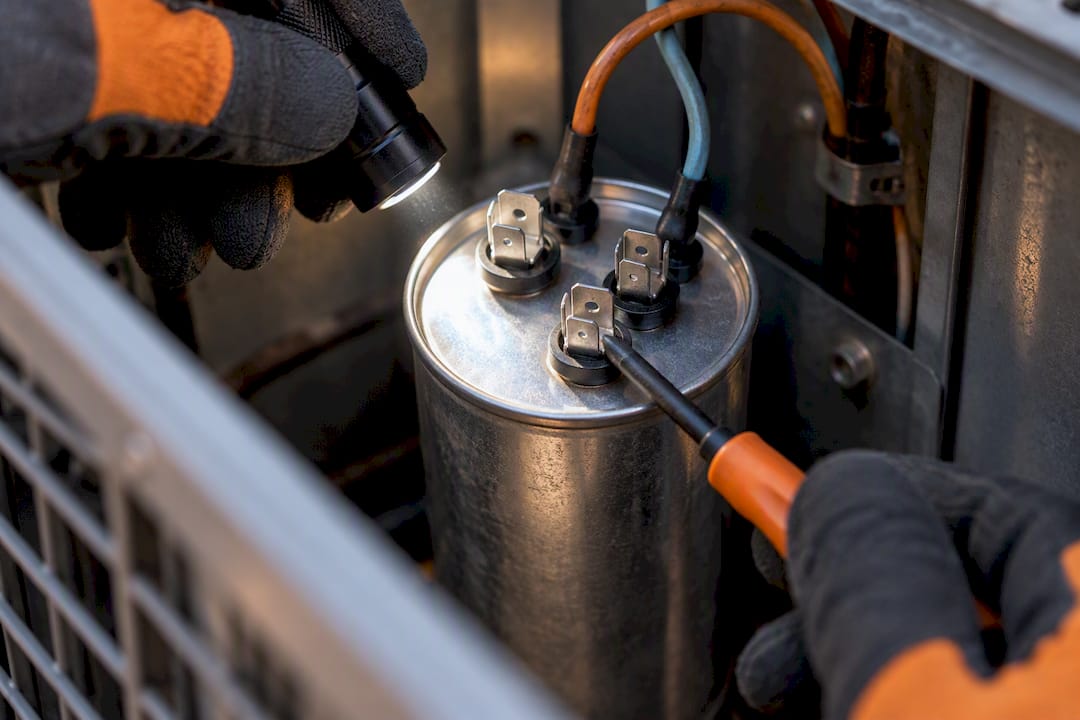
You can look, but don't touch. The capacitor sits inside the outdoor condenser cabinet, usually near the compressor, and it's typically a small cylindrical can about the size of a soda can or smaller, with a flat or slightly domed top.
A healthy capacitor has a flat top, clean metal casing, and no visible residue around the base. A failing one often tells its own story before a meter ever confirms it.
- Check for a bulged or domed top. Internal pressure from a breaking-down capacitor pushes the top outward, and a healthy one is flat.
- Look for leaked oil or fluid pooling at the base or dripping down the sides of the can.
- Scan for scorch marks or discoloration around the terminals, which suggest arcing or overheating.
- Check for split seams along the casing, a sign the capacitor has physically failed internally.
Before you look at any of this, turn the thermostat off, and if you're comfortable locating the outdoor disconnect switch or pulling the breaker, do that too. Never touch the terminals, probe them with a screwdriver, or attempt any DIY discharge trick. Capacitors store high-voltage charge that can remain dangerous even after the power is switched off, and that charge doesn't care whether the unit is unplugged.
Pro Tip: A lot of failed capacitors look completely normal from the outside. A flat top and clean casing don't rule out failure. If your symptoms match the list above and the capacitor looks fine, that's still a strong reason to call a technician rather than assume the part is good.
How Do Professionals Diagnose a Bad AC Capacitor?
A technician's diagnosis should rest on a number, not a guess. Two tools come into play, and knowing the difference helps you understand what you're paying for.
A standard multimeter can check for continuity or measure voltage, which tells a technician whether power is reaching the capacitor at all. It won't tell them the actual stored capacitance, though. For that, a technician uses a dedicated capacitance tester (sometimes called a capacitance meter), which measures the part's output in microfarads (μF) and compares it against the rating printed on the capacitor's label.
Every capacitor is rated with a tolerance, commonly ±5% or ±6%, and a good technician checks the live reading against that range rather than eyeballing it.
- A capacitor reading well below its rated μF, outside its printed tolerance, has degraded and needs replacement.
- A reading within tolerance while cold doesn't guarantee the part is healthy under real operating conditions.
- Some capacitors pass a cold test but fail once they heat up under summer load, which is why a thorough technician may run the system and retest, or use operational testing to catch intermittent failures a cold reading would miss.
- A reading of zero or infinite resistance on certain tests usually indicates a fully shorted or open capacitor.
Before agreeing to any capacitor replacement, ask the technician for the actual reading they measured and the printed rating on the part. A reputable HVAC company will show you both numbers and explain the gap, not just tell you the part is bad and hand you an invoice.
How Long Do AC Capacitors Last and What Does Replacement Cost?
Most AC capacitors last somewhere between five and ten years, though heat exposure, power quality, and how hard the system runs each summer all shift that window. Homes in consistently hot climates, or systems that cycle on and off frequently, tend to wear capacitors down faster than that range suggests.
Replacement is inexpensive relative to almost every other AC repair. Bryant's cost guidance puts the part itself in the $15 to $80 range, with a fully installed replacement, including labor and the service call, typically landing between $250 and $400 nationally. Your actual price depends on capacitor size, whether it's a single or dual unit, your local labor rates, and whether the visit uncovers additional wear on contactors or relays that strained alongside it.
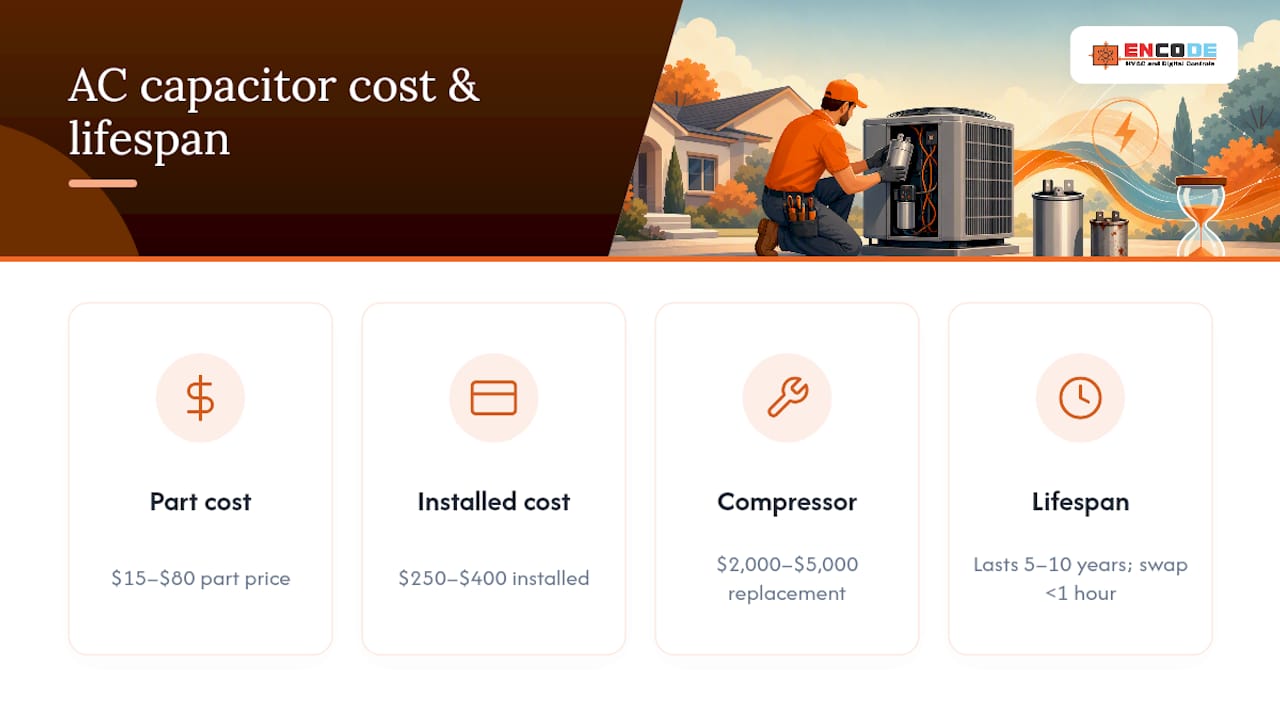
The timeline is usually short. A routine capacitor swap, once a technician has confirmed the diagnosis, typically takes well under an hour of hands-on work during a single visit. That speed is exactly why waiting doesn't make financial sense. A part that costs a few hundred dollars installed is protecting a compressor that costs thousands to replace, and every cycle you run on a failing capacitor adds strain to that motor.
How Can You Prevent AC Capacitor Failure?
Capacitor failure isn't entirely preventable since heat and age catch up with every unit eventually, but a few habits meaningfully lower your risk and catch problems before they leave you without cooling on the hottest day of the year.
- Schedule seasonal maintenance before your system faces peak summer load. A tune-up typically includes cleaning the condenser coil, tightening electrical connections, and testing capacitor readings against their rating, which is exactly the check that catches a weakening capacitor early. The Department of Energy recommends regular seasonal maintenance as one of the most reliable ways to preserve efficiency and avoid breakdowns.
- Keep the area around your condenser clear of leaves, mulch, and overgrown landscaping, since restricted airflow makes every component run hotter, including the capacitor.
- Watch for pests and corrosion inside the cabinet, since rodents and moisture can damage wiring and electrical covers that protect capacitor terminals.
- Ask about surge protection if your neighborhood has frequent power fluctuations or storm-related outages, since voltage spikes are a known accelerant of capacitor failure.
- Book service before hot season starts, right after a major storm, or the moment symptoms recur, rather than waiting for a complete breakdown on a 95 degree afternoon.
Routine maintenance carries a side benefit too. The EPA notes that keeping HVAC systems properly maintained supports better indoor air quality, since a system running as designed handles humidity and filtration more consistently than one limping along on failing components.
Why Call a Licensed Technician Instead of Fixing It Yourself?
Capacitors store enough electrical charge to be lethal, even with the system fully powered down. Licensed technicians know how to safely discharge a capacitor before ever touching it, following the same de-energize-first principle behind OSHA's electrical safe work practices. That single step is the reason this repair belongs to a professional, not a weekend project.
Beyond safety, speed matters. Technicians typically carry common capacitor sizes on their trucks, which means a confirmed diagnosis often turns into a same-day fix rather than a second visit and another day without cooling.
Before you approve any repair, ask for the actual capacitance reading measured against the part's printed rating, along with the part warranty and labor warranty covering the work. A technician who can't produce that documentation hasn't actually diagnosed anything.
A company with decades of experience handles residential air conditioning repairs in the Billings area, emphasizing fast local response and preventative maintenance plans designed to catch problems like a drifting capacitor before they become a no-cooling emergency.
Get Your AC Capacitor Checked and Fixed Fast
If any of the symptoms above sound familiar, the smartest move is getting a real diagnosis instead of guessing. Encode HVAC and Digital Controls handles AC repair, installation, and replacement for homeowners across the Billings area, and a capacitor check is one of the fastest, most affordable diagnoses a technician can run.

Encode's advantage isn't a call center reading from a script. It's a local team that shows up fast, tests the actual part with a capacitance meter, and tells you the number before recommending anything. That's the difference between a shop that guesses and one that documents. If your system is humming without spinning, blowing warm air, or tripping breakers, book a diagnostic visit through Encode's residential air conditioning page now, before a cheap part turns into an expensive compressor problem. Homeowners who want to get ahead of failures altogether can also look into Residential HVAC Maintenance Plans, which build capacitor and electrical checks into routine seasonal visits.
Trusted Resources on AC Capacitors and Maintenance
For homeowners who want to dig deeper on their own, a few sources are worth bookmarking. The Department of Energy's air conditioner maintenance guide covers general upkeep that extends system life. Trane's explainer on AC capacitors breaks down what the part does and why it matters. OSHA's electrical safe work practices standard explains the safety principles licensed technicians follow, and the EPA's indoor air quality guide connects HVAC upkeep to the air you breathe at home.
Sources
- AC Capacitor Replacement Guide: Signs, Costs & Repair Steps — Bryant
- Heat pump capacitor — Trane troubleshooting resource
- 1910.333 — Selection and use of work practices — OSHA
- Care for your air — EPA indoor air quality guide
FAQ
Will an AC Compressor Run With a Bad Capacitor?
Usually not, or only poorly. A weak capacitor can't deliver the startup jolt the compressor motor needs, so it either fails to start, hums without engaging, or starts and strains under excessive current until a thermal switch shuts it down.
What Happens When My AC Capacitor Goes Bad?
The compressor and fan motors lose the electrical boost they need to start and run efficiently, leading to symptoms like humming, warm vents, hard starts, or complete failure to start. If ignored, the extra strain on the motor windings can cause secondary damage that's far more expensive than replacing the $15 to $80 capacitor itself.
What Are the Two Typical Signs That a Capacitor Has Failed?
The two most recognizable signs are a humming outdoor unit with a fan that won't spin, and hard or delayed starts where the system clicks or struggles before finally kicking on. Both point to insufficient starting capacitance and warrant a professional capacitance test.
What Is the Average Lifespan of an AC Capacitor?
Most AC capacitors last roughly five to ten years, though heavy heat exposure and frequent cycling can shorten that. A seasonal tune-up that includes a capacitance check is the most reliable way to catch a weakening capacitor before it fails during peak summer heat.